Real leather vs. faux leather: the difference and how to spot it
What faux leather is, how it differs from real leather and how to tell them apart by touch and after a year of use. An honest comparison for desk mats, including ecology and cost.
What faux leather is, and why it is not leather
Faux leather, PU leather, leatherette, pleather and vegan leather are names for one and the same material: a thin layer of plastic, usually polyurethane (PU), sometimes PVC, applied to a textile backing and printed with a pattern that imitates the grain of leather. “Vegan” and “eco” say nothing about certification or origin; sellers use them because they sound better than “plastic”.
Faux leather is common on mouse pads and desk mats because it is cheap, prints easily and looks almost like leather in a shop photo. The difference shows as soon as you pick it up, and above all after a few months of use.
How to tell the difference at first touch
You do not need to be a tanner. Notice five things:
- Grain. Real leather has an irregular surface: fine pores, veins, slight shifts in tone. Faux leather has a pattern pressed in by a roller, so it repeats every few centimetres.
- Warmth. Rest your palm on the surface. Leather takes on the warmth of your hand in seconds; plastic stays cold longer.
- Smell. Leather smells of leather. Faux leather smells of chemicals, or of nothing, and the smell fades in a few weeks.
- Edge. On a cut edge of real leather you see fibres through the whole thickness. On faux leather you see a thin coloured layer and a textile mesh beneath it.
- Bend. Leather bent sharply forms fine creases that smooth out again. Faux leather cracks or whitens permanently.
After a year on the desk
The biggest difference is not on day one but after a year. A mat sits under your hands eight hours a day: wrists rub on it, the mouse travels across it, you put mugs down on it. Real leather responds by darkening, softening and gaining a sheen where it is touched; that is patina, the reason an old leather object looks better than a new one. Faux leather responds the other way: the plastic layer first goes shiny where it rubs, then cracks, and finally peels until the textile shows through.
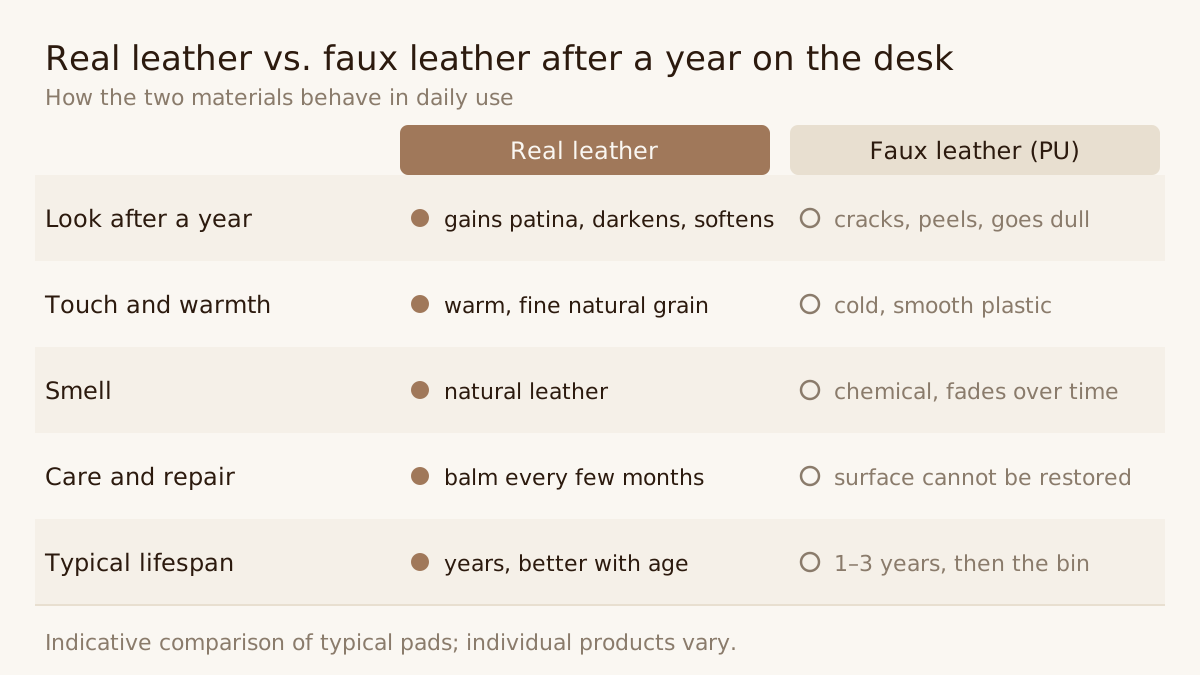
How the two materials behave in daily use. An indicative comparison of typical pads; individual products vary.
Leather can also be looked after: a colourless balm every few months keeps it supple, and a scratch from a set of keys disappears into the patina over time. A damaged faux leather surface cannot be repaired; once it starts peeling, replacement is the only option.
Is faux leather greener?
Despite the names, usually not. Polyurethane and PVC are made from oil, solvents are used in production, and the material does not break down in nature. Because a faux leather mat lasts one to three years, it goes in the bin several times over the life of one leather mat.
Real leather has its own footprint, chiefly in tanning, and it is fair to say so. But it is a by-product of the food industry: animals are not raised for their hides, and a hide that would otherwise be discarded becomes an object that serves for a decade. For Deskhide pads we use hides from European tanneries, which work under European limits on effluent and chemicals.
If you want no animal material at all, cork or wool felt are better choices than faux leather: they do not peel either, and they come from renewable sources.
Cost per year of use
A faux leather mat typically costs €15 to €35; our leather desk mat costs €129. The gap looks large until you divide by years of service. Faux leather lasts one to three years before it peels; leather serves for years and looks better with age. Per year of use leather comes out similar or cheaper, not counting the time spent choosing and ordering replacements.
When faux leather makes sense
Honestly: where you need a cheap surface for a short time, or where only the colour matters and not the touch. A shared meeting room, a child’s desk or a temporary fix in a rented office will do fine. Under the hands where you spend most of the working day, we would not recommend it.
In short
Faux leather is plastic pretending to be leather, and after a year it shows. Real leather costs more, but it holds the warmth of your hand, can be cared for, and matures instead of degrading. If you want a mat that stays on your desk for years, see our leather desk mat or leather mouse pad, and read how to look after them in the leather care guide.
Frequently asked questions
Is faux leather leather?
No. Faux leather, PU leather and vegan leather are trade names for a plastic layer, usually polyurethane, applied to a textile backing. It shares only its looks with leather.
How do I tell real leather from faux leather?
Real leather has an irregular grain with fine pores, warms quickly under the hand and smells of leather. Faux leather has a regular repeating pattern, feels cold and smooth and smells of chemicals or of nothing.
Is faux leather more ecological than real leather?
Despite the names, usually not. It is petroleum-based plastic that is thrown away after a year or two and does not break down. Real leather is a by-product of the food industry and lasts for years with basic care.